

Vouching has moved from textbook jargon to a live point of scrutiny as regulators, auditors, and even election officials revisit how claims are backed by evidence. From corporate audits to courtroom arguments and voter registration rules, the practice of formally “vouching” for a transaction, person, or statement now sits inside wider debates about trust and verification. The renewed attention is less about redefining the term and more about how rigorously it is applied when money, credibility or votes are at stake.
In financial auditing, vouching has long been described as the backbone of the profession, but the focus has shifted toward how it works in a data-heavy, automated environment. Similar tensions are emerging in legal and electoral settings, where vouching rules are being tightened, defended, or quietly rewritten. Against that backdrop, the meaning, importance, and real-world examples of vouching are once again being tested in public.
The working keyword for this piece is “vouching meaning importance examples,” which reflects the way the term is being reconsidered in technical and public-facing discussions.
Defining vouching in practice
Technical meaning in auditing
In financial auditing, vouching is the inspection of documentary evidence that substantiates a recorded transaction, carried out by an auditor to establish that it is genuine, authorized, and correctly recorded. Rather than accepting ledger entries at face value, the auditor traces them back to source documents such as invoices, receipts, debit and credit notes, or contracts to confirm that the transaction actually occurred and relates to the business.
This technique is described in professional literature as the “essence” or “backbone” of auditing because the reliability of financial statements rests heavily on how thoroughly vouchers are checked. Vouching meaning importance examples in this context tend to focus less on theory and more on how a single missing or altered document can undermine an entire audit opinion.
Broader meaning beyond finance
Outside accounting, vouching carries a more general sense of one party backing the credibility of a claim, statement, or person by offering assurance or evidence. In legal discussions, the term can refer both to prosecutorial “vouching” for a witness’s credibility – often viewed skeptically by courts – and to older civil procedures in which one defendant calls another into a case and seeks to bind them to the outcome.
In public policy debates over voting rules, vouching commonly describes a mechanism where an eligible voter attests to the residency or eligibility of another person who lacks conventional documentation. Here, vouching meaning importance examples revolve less around ledgers and more around whether such assurances open a door to irregularities or simply prevent eligible voters from being turned away.
Core elements of vouching
Across fields, three elements recur: a claim, supporting evidence, and a responsible party offering that support. In auditing, the claim is a transaction; the evidence is the voucher; the responsible party is the auditor, who signs off that the records are backed by documents. In elections, a registered voter may effectively become the “voucher,” and the claim concerns residency or identity, rather than a financial figure.
Vouching meaning importance examples often pivot on how robust each of these elements is. Weak evidence, a conflicted voucher, or a vague claim can all undermine the value of the process, whether in a set of accounts or at a polling place.
Distinction from verification
Specialist texts draw a sharp line between vouching and verification, particularly in auditing practice. Vouching focuses on the authenticity and authorization of transactions in the books, while verification addresses whether the assets and liabilities reported actually exist and are properly valued. Vouching might match a purchase entry to an invoice; verification would involve confirming that the purchased asset is still in use and recorded at an appropriate figure.
This distinction matters because an auditor can complete extensive vouching and still miss issues around valuation or existence, such as obsolete inventory or impaired assets. Vouching meaning importance examples therefore tend to be framed as one part of a wider toolkit, crucial but not sufficient on its own.
Why “backbone of auditing” persists
The phrase “backbone of auditing” continues to appear in accounting education and practice notes, reflecting a view that without rigorous vouching, other procedures may rest on unstable ground. When vouchers are examined closely, auditors gain a clearer picture of whether internal controls are working, whether transactions are properly authorized, and whether the recorded flow of money matches the paper trail.
This status has legal implications. Case law has shown that auditors who neglect obvious red flags in vouchers – such as suspicious wage records or unusual cash payments – can face findings of negligence for failing to exercise due care. Vouching meaning importance examples in training materials often return to these judicial findings to illustrate how lapses in basic documentation checks can escalate into professional liability.
Why vouching matters now
Vouching and fraud detection
Auditing guidance repeatedly links vouching to the detection of fraud and irregularities, especially those that would not be visible from ledger checks alone. By comparing recorded entries with underlying documents, auditors can spot fictitious vendors, duplicated payments, inflated revenues, or personal expenses run through business accounts.
Vouching meaning importance examples frequently highlight situations where discrepancies in dates, amounts, or authorizations on vouchers have triggered wider probes. When inconsistencies appear, auditors may expand their sample sizes or adjust other procedures, which can increase audit costs but is seen as necessary to gain assurance about the integrity of the records.
Confidence in financial reporting
Regulators and professional bodies emphasize that vouching underpins trust in financial statements by establishing that recorded transactions are not only accurate but also properly authorized and business-related. Thorough vouching helps support an unqualified audit opinion, and in turn, that opinion influences how investors, lenders and other stakeholders view the credibility of a company’s reporting.
In this environment, vouching meaning importance examples often center on how strong documentation testing can reassure markets after high-profile accounting scandals. Stakeholder confidence can be reinforced when audits explicitly reference the robustness of vouching and related procedures, especially in sectors where complex transactions or rapid growth raise questions about oversight.
Regulatory expectations and auditor liability
Regulatory frameworks and professional standards expect auditors to design procedures that respond to the risk of material misstatement, whether from error or fraud, and vouching sits at the heart of that response. When vouching is superficial, oversight bodies and courts may question whether due care was applied, particularly if fraud emerges later in areas where documents showed obvious anomalies.
Legal commentary points to instances where wage sheets, cash vouchers or other primary evidence contained facially suspicious entries that were not pursued, contributing to findings of negligence. Vouching meaning importance examples therefore often serve as cautionary narratives in professional training, reinforcing that the process is not a formality but a central duty.
Technology and data-heavy environments
Recent academic and professional articles describe how vouching has been reshaped by technological change, especially the shift toward digital records, automated systems, and data analytics. Rather than physically inspecting stacks of paper vouchers, auditors increasingly rely on audit software and AI-driven tools to flag anomalies and select transactions for deeper review.
These developments have not removed the need for vouching; they have altered its scale and focus. Vouching meaning importance examples now include automated matching of invoices, electronic approvals, and system logs, alongside traditional document checks. The challenge lies in ensuring that automation enhances scrutiny rather than encouraging overreliance on system outputs.
Public debates over electoral vouching
Outside corporate reporting, the term vouching has emerged in politically sensitive debates over voter identification and registration procedures. In Minnesota, for example, rules allow a registered voter to vouch for up to eight individuals seeking same-day registration by attesting to their residency, a policy that has drawn criticism from those concerned about fraud risks. Officials note that the vouching provision has been in place for decades and is most often used in settings such as senior living facilities, where residents may lack up-to-date identification.
National and provincial debates in Canada have likewise scrutinized vouching as a way of balancing access to the ballot with the need to guard against irregularities, with reports documenting administrative errors in how vouching was recorded and tracked. In these contexts, vouching meaning importance examples are mobilized by both critics and defenders as they argue over whether the mechanism strengthens or weakens electoral integrity.
How vouching works in detail
From books to vouchers
In standard audit practice, vouching often begins with entries in the books of account and moves backward to the original supporting documents. A sales figure in a ledger might be traced to an invoice, shipping document, customer order, and receipt; a cash payment could be matched to an approved voucher, vendor invoice, and evidence of delivery.
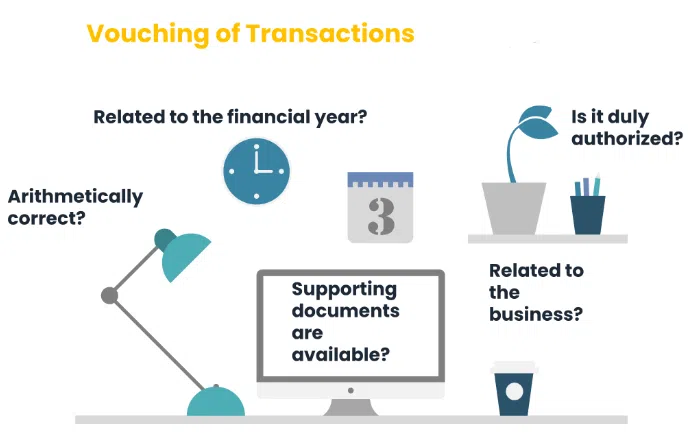
Guidance materials stress the need to confirm multiple attributes: that the transaction occurred, that it relates to the entity, that it is properly authorized, and that it appears in the correct period and account classification. Vouching meaning importance examples often describe how a mismatch between voucher dates and recording dates can reveal cut-off errors that affect reported performance.
Common vouching procedures
Training notes and textbooks outline a suite of techniques used during vouching, including arranging vouchers according to book entries, checking dates and serial numbers, confirming arithmetic accuracy, and ensuring that documents are stamped “paid” or “cancelled” to prevent duplicate use. For cash receipts, auditors may verify counterfoils of receipt books, match them to cash book entries, and confirm that receipts were recorded on the date cash was actually received.
For cash payments and trading transactions, procedures include confirming that payments were made to the correct parties, that they were properly sanctioned, and that personal transactions have not been recorded as business expenses. Vouching meaning importance examples here highlight instances where such checks have uncovered unauthorized payments or misclassified personal expenses.
Vouching different types of transactions
Specialist materials treat sales, purchases, cash receipts, and cash payments as distinct vouching areas, each with its own focus. For cash sales, auditors may examine cash memos, daily summaries from sales staff and cashiers, and cash register tapes, comparing these with entries in the cash book and general ledger. For credit sales and purchases, they may vouch entries in subsidiary books against invoices, dispatch notes, and goods received notes, and reconcile these with personal ledgers.
In hire-purchase or installment transactions, vouching can extend to verifying schedules of installments received, confirming calculations of profit recognition, and checking that repossessions or defaults are appropriately recorded. Vouching meaning importance examples in educational settings frequently walk through these transaction-specific checks to demonstrate how the same core principle applies across different revenue and expense streams.
Tracing versus vouching
Modern audit discussions often pair vouching with “tracing,” another core technique. Tracing typically starts from source documents and moves forward into the accounting records to test completeness, ensuring that all valid transactions have been recorded. Vouching, by contrast, starts from recorded entries and tests whether they are supported by underlying evidence, addressing authenticity and occurrence.
Together, tracing and vouching provide a two-way test: one checks whether anything is missing; the other checks whether anything recorded is fictitious or unsupported. Vouching meaning importance examples in this paired framework often show how auditors use both methods to address different audit assertions and risk areas within the same engagement.
Cost and scope decisions
Vouching is resource-intensive, and audit guidance acknowledges that extensive document testing can increase engagement costs, particularly when errors require enlarging sample sizes. When vouching uncovers anomalies, auditors may decide to broaden testing or to apply alternative procedures, weighing the need for assurance against time and fee constraints.
Firms therefore face ongoing decisions about how much vouching is necessary in each area, based on risk assessments, materiality thresholds, and the strength of internal controls. Vouching meaning importance examples within practice management discussions often return to the idea that money spent on strong controls and clean documentation can reduce the extent of vouching required and, ultimately, the overall cost of audit work.
Vouching across sectors: examples
Classic audit examples
Illustrative cases used in accounting education typically involve a company submitting its financial statements and books for audit, with vouching applied to a range of transactions. In one example, an auditor reviews entries such as cash sales, receipts from debtors, interest income, dividend income, mortgage payments, and fixed asset sales, seeking corresponding documentation for each. By matching entries to receipts, capital expenditure vouchers, and other evidence, the auditor can conclude that the transactions are valid, business-related, and properly authorized.
Other examples describe auditors vouching inventory by tracing physical items to records or starting from inventory records and checking existence on warehouse shelves, illustrating how vouching can work in both directions. Vouching meaning importance examples here underline the link between document testing and broader assertions about asset existence and transaction legitimacy.
Legal cases on negligence
Legal precedents show how failures in vouching can lead to findings of professional negligence. In the case of Armitage v. Brewer and Knott, auditors were criticized for not displaying reasonable care and skill in vouching wage sheets, which allowed fraud in wage records and cash vouchers to go undetected. The judgment noted that several documents were suspicious on their face and should have prompted further inquiry, reinforcing that vouching is not a box-ticking exercise but a substantive test.
Commentary on such cases is frequently used in professional training to highlight personal exposure for audit partners when vouching is neglected. Vouching meaning importance examples drawn from these rulings emphasize that the duty of care includes recognizing and pursuing anomalies in the documentation, rather than merely confirming that documents exist.
Electoral vouching controversies
In Minnesota, renewed scrutiny has fallen on an election rule permitting a registered voter to vouch for up to eight individuals seeking same-day registration, with critics arguing that the arrangement could be abused and supporters pointing to its role in helping eligible voters without current ID. Officials have stressed that the policy has existed for more than 50 years and is most commonly used in senior living facilities or where voters have recently moved.
Earlier debates in Canada over federal reforms highlighted administrative errors in the use of vouching, including incomplete records in poll books and instances where vouchers did not reside in the same polling division as vouched voters. In these disputes, vouching meaning importance examples are deployed by both sides: for some, vouching is a safeguard against disenfranchisement; for others, it is a potential weak point in election integrity that demands tighter controls or replacement.
Prosecutorial vouching in courtrooms
In criminal law, the term “vouching” often refers to situations where a prosecutor improperly suggests to a jury that a witness is credible based on personal belief or information outside the evidence presented. Courts typically view such statements as problematic because they risk substituting the advocate’s authority for the jury’s independent assessment of the evidence.
Legal reference materials explain that while prosecutors can argue from the record that a witness is believable, they are not permitted to imply that they know more than the jury or that the government has secretly verified the testimony. Vouching meaning importance examples in this domain thus concern fair trial safeguards, focusing on the boundary between robust advocacy and impermissible endorsement.
Technology-driven vouching trends
As organizations move toward digital workflows, vouching increasingly relies on electronic records, audit trails, and automated tools, rather than physical vouchers alone. Recent papers describe how data analytics, artificial intelligence, and machine learning are being deployed to detect anomalies and flag transactions for closer review, effectively reconfiguring how vouching samples are selected and evaluated.
Audit software such as ACL Analytics, IDEA, CaseWare, and TeamMate is cited as helping to streamline tracing and vouching by automating document matching and exception reporting. Vouching meaning importance examples now often involve dashboards of flagged items and digital approval workflows, raising questions about how auditors verify the integrity of electronic evidence and resist overreliance on automated scoring.
Conclusion
Public records show that vouching has retained its status as a core mechanism for testing claims wherever documentary evidence is central, but the environments in which it operates are changing quickly. In financial auditing, courts and regulators still treat vouching as a basic duty, especially when fraud or misstatement later comes to light, and training materials continue to describe it as the backbone of assurance work. In elections and legal proceedings, the same term now anchors debates over voter ID rules and fair-trial standards, indicating how far its implications reach beyond balance sheets.
Despite this breadth, much remains unresolved about what robust vouching looks like when evidence is largely digital, automated systems generate their own audit trails, and human reviewers are expected to interpret machine-selected anomalies. Emerging use of AI and analytics can strengthen the process, but it also shifts attention to new points of vulnerability: data quality, system design, and the possibility that subtle forms of manipulation may escape conventional document checks.
Vouching meaning importance examples will likely continue to evolve as regulators test new rules, courts weigh fresh disputes, and professional standards adjust to technology-intensive practices. What is publicly established is that the concept remains central wherever institutional trust depends on documented corroboration. What has not yet been settled is how much assurance societies are prepared to place in digital vouchers and algorithmic filters – and how accountability will be enforced when those mechanisms fail.