
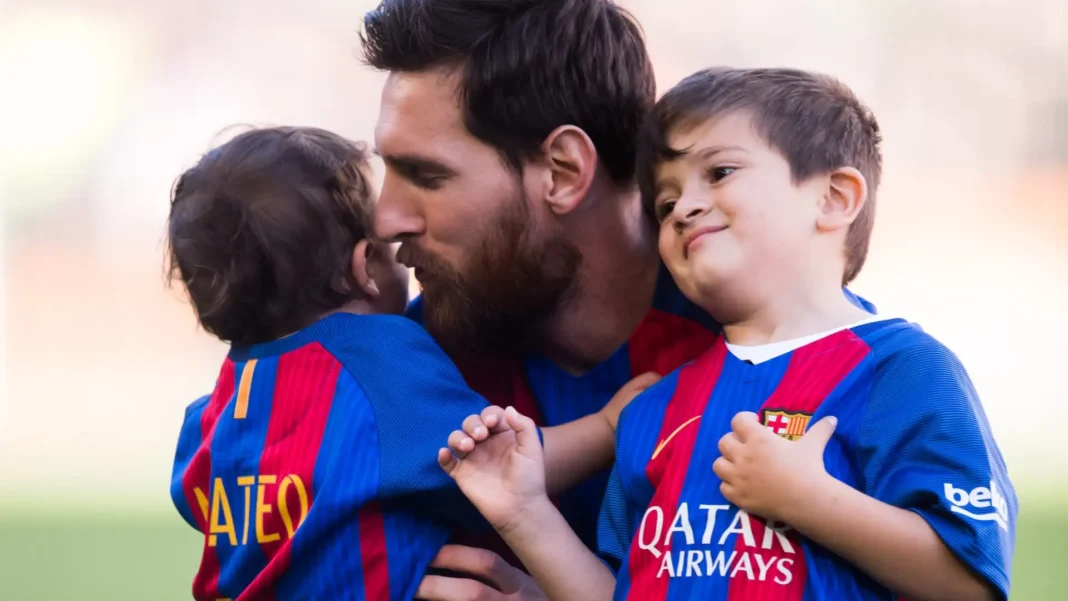

Lionel Messi children news reveals how one of football’s most recognizable figures integrates family life into public narrative without surrendering privacy entirely. Messi has three sons with his wife Antonella Roccuzzo—Thiago, Mateo, and Ciro—and the family’s visibility has increased alongside the footballer’s career trajectory, particularly around major tournament moments.
The story behind Lionel Messi children news isn’t about gossip or speculation—it’s about generational legacy construction, the economics of public exposure, and how elite athletes manage the tension between personal life and commercial brand demands. These dynamics offer insights that extend well beyond sports into any domain where individual reputation carries economic weight.
Generational Legacy Pressure And The Football Inheritance Question
All three of Messi’s sons have shown interest in football, with the older two signing to youth academies during the family’s time in Paris and subsequently joining Inter Miami’s development programs. This creates complex dynamics around expectation management—both public and private.
Thiago and Mateo playing organized football inevitably generates comparisons to their father, a standard that no young player could reasonably meet. Yet Messi has publicly stated his approach prioritizes enjoyment over pressure, allowing his children to engage with the sport on their terms.
That framing—”I leave him to enjoy playing football and I don’t put any pressure on him”—functions as both parenting philosophy and public relations strategy. It signals to media and fans that expectations should be tempered while establishing a protective boundary around the children’s development. Whether that boundary holds under sustained attention remains an ongoing test.
Visibility Strategy And The Calculated Deployment Of Family Moments
Messi’s family became significantly more visible during Argentina’s World Cup victory, where all three sons joined celebrations on the field wearing jerseys with their father’s number. Images of the boys embracing Messi after the final circulated globally, creating emotional resonance that transcended sports coverage.
This visibility wasn’t accidental. Major tournament moments offer athletes opportunities to humanize their public image at scale, and family inclusion amplifies emotional connection with audiences. The calculation involves balancing protective instincts with recognition that shared celebration generates goodwill and deepens fan investment in the athlete’s narrative.
Mateo, the middle child, has become particularly recognized for viral moments, including throwing a lollipop during a match and his visible excitement around trophy presentations. These moments generate massive social media engagement precisely because they feel unscripted and authentic, offering audiences glimpses of personality that polished brand content cannot replicate.
The Migration Reality And Childhood Disruption Across Career Moves
Messi’s career has required the family to relocate multiple times, from Barcelona to Paris to Miami, with each transition involving educational changes, social network disruption, and cultural adaptation for the children. All three sons were born in Barcelona, making subsequent moves particularly significant as the family navigated identity and belonging across different cities and languages.
This pattern reflects a common challenge among high-mobility professionals: career optimization often conflicts with childhood stability. The tradeoff isn’t unique to athletes—executives, diplomats, and military families navigate similar tensions. But the public visibility around Messi’s moves adds external pressure that most families don’t face.
From a practical standpoint, managing these transitions requires significant infrastructure: new schools, language support, social integration strategies, and maintaining continuity through deliberate rituals and routines. The Messi family’s ability to navigate multiple relocations while maintaining cohesion speaks to both resource access and intentional relationship investment.
Youth Development Context And The Intersection Of Privilege And Talent
Messi’s sons train within elite academy structures, first at PSG and now at Inter Miami, environments that provide exceptional coaching and development resources. This access creates opportunities that the vast majority of young players never encounter, raising questions about meritocracy, privilege, and how talent is identified and cultivated.
The reality is that children of elite athletes benefit from compound advantages: genetic predisposition, early exposure to high-level training, access to world-class facilities, and observation of professional standards from childhood. These advantages don’t guarantee success—plenty of athletes’ children don’t reach professional levels—but they do create significantly higher probability pathways.
The broader lesson applies to advantage distribution across any field. Early access to quality resources, mentorship, and network connections dramatically influences outcome distributions. Acknowledging that reality doesn’t diminish individual effort, but it does provide necessary context for understanding why success clusters within certain populations and families.
The Privacy Tradeoff And Long-Term Autonomy Considerations
As Messi’s sons grow older and their involvement in football becomes more structured, the tension between family privacy and public interest will likely intensify. Youth football content featuring the Messi boys already generates substantial viewership, indicating strong audience appetite for updates on their development.
This creates a decision point for the family: lean into that visibility and potentially monetize attention, or resist it to preserve the children’s autonomy over their future public presence. Neither approach is inherently correct—each carries distinct benefits and costs.
What I’ve learned from observing these dynamics across industries is that families who navigate this successfully tend to establish clear principles early and resist erosion through incremental exceptions. The first yes to a request that violates boundaries makes subsequent refusals more difficult. Maintaining protective limits requires accepting that saying no disappoints people and leaves opportunities unclaimed. That’s the practical cost of prioritizing long-term autonomy over short-term engagement, and it requires conviction to sustain over time.