
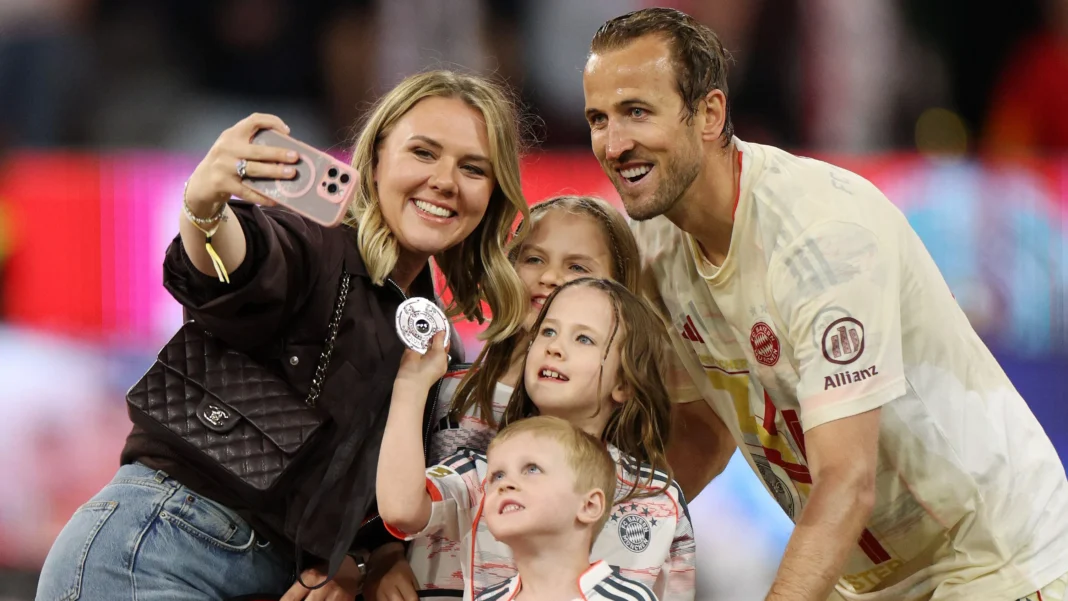

Harry Kane children news functions less as tabloid fodder and more as lifestyle documentation of one of football’s most prominent families navigating major career transitions across international borders. Kane and his wife Kate, childhood sweethearts who married after years together, now have four children—two daughters and two sons—and their family life has become intertwined with Kane’s professional trajectory in ways that affect logistics, public perception, and strategic decision-making.
The couple welcomed their youngest son, Henry, shortly after Kane completed his high-profile transfer from Tottenham to Bayern Munich, which meant coordinating a birth in England while Kane was establishing himself in Germany. That’s not just family planning. It’s operational complexity that intersects with career milestones and public visibility.
Timing Decisions And The Strategy Of International Family Transitions
When Kane transferred to Bayern Munich, Kate was heavily pregnant with their fourth child. The couple made the deliberate choice to have the birth in England rather than Germany, which meant Kane initially lived in a hotel in Munich while Kate remained in the UK. That’s a calculated tradeoff: personal convenience and medical continuity versus professional proximity.
Here’s the bottom line: high-stakes career moves don’t happen in isolation. They affect entire family systems, and the logistics of international relocation with young children—especially when a birth is imminent—require phased transitions rather than immediate moves. The data tells us that disruptive family transitions during critical professional periods correlate with decreased performance and increased stress, so staging the move reduces risk.
Kate documented the family’s eventual move to Germany on social media, including images of the family at Bayern’s Allianz Arena and settling into their new home in an area nicknamed “The Beverly Hills of Bavaria“. That’s narrative management. By showing the transition as smooth and successful, she counters potential speculation about difficulty adjusting or regret about leaving England.
Family As Professional Asset And The Economics Of Public Support
Kate Kane has been photographed at major tournaments and matches supporting Harry, and their children are often visible in celebratory moments on the pitch. That visibility isn’t accidental. It reinforces the image of Kane as a stable family man, which enhances his marketability and softens his public persona beyond just being a goal-scorer.
Look, what I’ve learned is that family visibility for professional athletes functions as brand reinforcement. It humanizes figures who might otherwise be seen only through the lens of performance metrics. For sponsors and media partners, a stable family image signals reliability and broad appeal—it extends Kane’s audience beyond hardcore football fans to include lifestyle and family-oriented demographics.
The reality is that this kind of visibility is strategic. Kate’s social media presence is curated but accessible. She shares enough to satisfy public curiosity without exposing private details that could become invasive. That balance is critical: too little sharing invites speculation, too much invites intrusion.
Age Gaps And The Logistics Of Multi-Child Parenting During Career Peaks
Kane’s children range from age seven down to just over one year old. That’s a seven-year span, which means the family is simultaneously managing school-age children, toddlers, and an infant—all while Kane is at the peak of his professional career and Kate is managing a household in a foreign country.
From a practical standpoint, that’s intensive logistical coordination. School schedules, childcare, travel for matches, and maintaining stability for young children all have to be balanced against Kane’s training and competition demands. The fact that Kate has explicitly acknowledged taking primary responsibility for childcare isn’t just traditional role division—it’s operational necessity when one parent’s career requires near-total focus and frequent travel.
Here’s what actually works: clear role division, reliable support systems, and financial resources sufficient to hire professional help. Kane’s family has all three. That doesn’t eliminate stress or complexity, but it does mean the challenges are logistical rather than existential. The difference is significant, and it’s why high-income professional athletes can sustain large families during career peaks in ways that would be untenable for lower-income workers.
Cultural Adjustment And The Pressure Of Relocation With Young Children
Moving from England to Germany with four young children is a significant cultural and logistical shift. Language barriers, different schooling systems, unfamiliar healthcare structures, and social network disruption all affect family stability. For Kane, the professional benefits of the Bayern move—higher salary, elite competition, trophy opportunities—had to outweigh those family costs.
The data tells us that international relocations with children create adjustment periods that can last months or even years. Kate’s documentation of the move on social media suggests a smooth transition, but that’s curated content. The reality is likely more complex: navigating new systems, building new social connections, and helping children adjust to unfamiliar environments while Kane is focused on on-pitch performance.
What’s really happening here is a calculated bet that professional success in Germany will justify the disruption. If Kane wins trophies and maintains elite performance, the move is validated and the family adjustment becomes a footnote. If performance falters or family adjustment proves more difficult than anticipated, the narrative shifts toward questions about whether the move was worth it.
Public Milestones And The Intersection Of Career And Family Timelines
Henry’s birth coincided with Kane’s first weeks at Bayern, and Kane scored his first goal for the club just days before his son was born. That’s narrative symmetry that media outlets highlighted extensively—new club, new goal, new baby. It frames the transition as holistically successful, a new chapter that’s thriving both professionally and personally.
Here’s the reality: those kinds of coincidences are amplified because they fit clean storylines. But they also create pressure. If performance dips or family challenges emerge, the contrast becomes stark. The initial framing was “everything’s going right,” which means any subsequent difficulty will be framed as “what went wrong.” That’s the risk of allowing professional and personal milestones to be narratively intertwined. Harry Kane children news will continue to surface as the family grows and adjusts, but the underlying story is really about how high-performing professionals manage complex life transitions while maintaining public expectations of seamless success.