
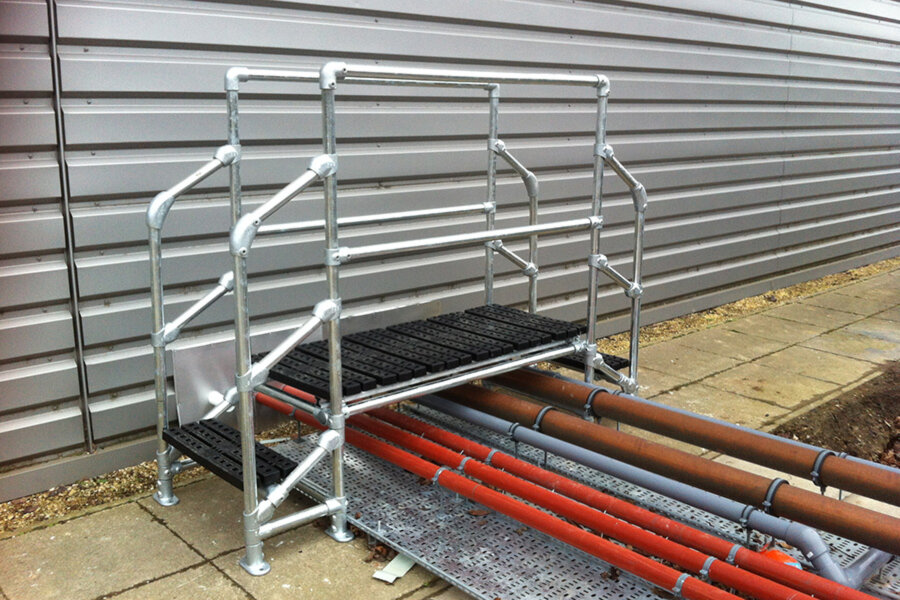

Safe access is a fundamental requirement across industrial, infrastructure, and utility environments. Walkways and platforms must support regular foot traffic while remaining secure in wet, oily, or chemically exposed conditions.
Designing these systems effectively requires careful consideration of materials, surface performance, and long-term durability.
Key Safety Risks in Industrial Access Areas
Access routes in industrial environments are exposed to conditions that can quickly compromise safety if not properly managed. Common risks include:
- Slippery surfaces caused by moisture or contaminants
- Structural degradation over time
- Electrical conductivity in hazardous areas
- Inconsistent surface performance
These risks highlight the importance of selecting materials that prioritise safety as well as strength.
The Role of Slip Resistance and Surface Performance
Slip resistance is one of the most important performance factors for industrial walkways. Surfaces must provide reliable grip even when exposed to water, oils, or chemicals.
Composite flooring systems are often designed with integrated anti-slip surfaces, removing the need for additional coatings. In many projects, grp grating is specified because it provides consistent slip resistance alongside structural stability.
Structural Performance Without Excess Weight
Heavy flooring systems can place unnecessary loads on supporting structures and complicate installation. Lightweight materials with high strength-to-weight ratios can simplify both design and construction.
Using solutions such as grp grating allows designers to meet load requirements while reducing handling effort and installation time, particularly in retrofit or restricted-access environments.
Electrical Safety and Environmental Considerations
In environments where electrical safety is critical, non-conductive materials offer an additional layer of protection. Composite materials do not conduct electricity and maintain performance in wet or corrosive conditions.
Manufacturers like engineered composites develop access solutions that address these safety requirements while delivering long-term durability.
Final Thoughts
Designing safe industrial access systems involves more than meeting basic load requirements. Material choice plays a crucial role in controlling slip risk, reducing maintenance, and ensuring long-term reliability.
By focusing on performance and safety from the outset, industrial facilities can create access environments that support both operational efficiency and workforce protection.